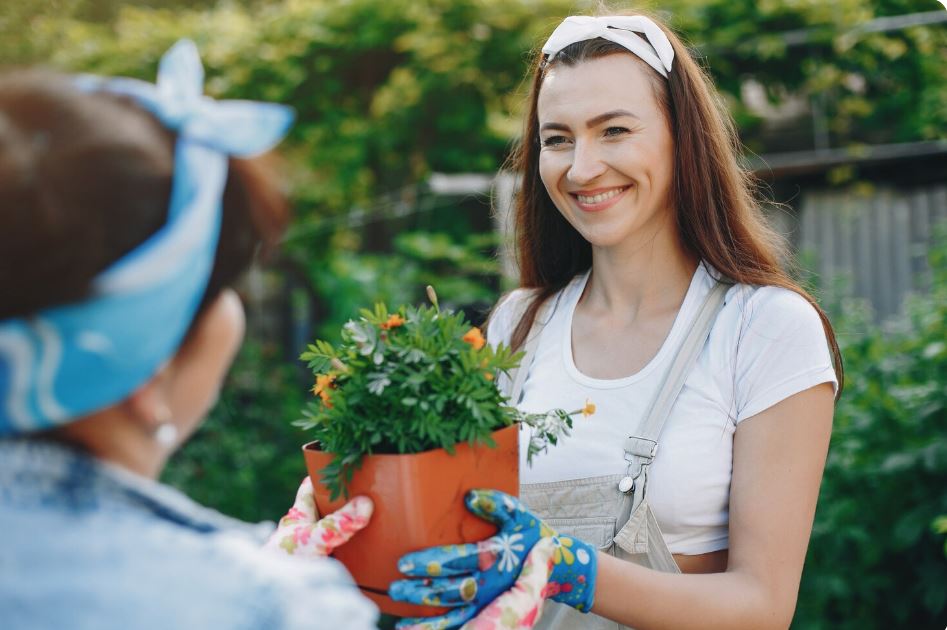
It was in a backyard, not a therapy session, that I witnessed grief begin to ease in real time for the first time. Rather than offering words of comfort, my elderly neighbor, who had recently lost her partner, gave me a trowel. “Just dig,” she instructed. “You’ll see.”
What started out as a courteous offer to cut a bush evolved into something subtly transformative. After thirty minutes of pulling weeds under a cloudless sky, I felt a slight release that was calming rather than cathartic. I remembered that moment.
| Factor | Insight |
|---|---|
| Psychological Impact | Reduces stress, anxiety, and depression while enhancing overall mood |
| Biological Mechanism | Soil microbes stimulate serotonin; gardening activity releases dopamine |
| Physical Activity Level | Offers low-impact, consistent movement beneficial to mental well-being |
| Cognitive Benefits | Encourages patience, problem-solving, and mindfulness |
| Social Interaction | Fosters connection through shared spaces like community gardens |
| Scientific Backing | Supported by studies from Princeton, NIH, and major psychology journals |
In recent years, mental health practitioners have focused more on the garden—not as a metaphor, but as a very powerful tool for mental health. What many gardeners already know is confirmed by research from organizations like Princeton and Psychology Today: planting seeds also plants resilience.
Growing a garden is always one of the most emotionally satisfying things to do. In terms of elevating mood, it is ranked second only to eating and exercise, according to a recent study published in Landscape and Urban Planning. However, it is based on gentle focus and rhythm rather than dopamine-fueled distractions.
The biological underpinnings of this calm are especially intriguing. Mycobacterium vaccae, a microbe found in soil, causes the brain to produce more serotonin. This microscopic organism stimulates a natural antidepressant effect through skin contact or inhalation. Touching the soil and feeling less overwhelmed is an incredibly straightforward exchange.
However, the effects of gardening go well beyond microbes and mood. It teaches patience. In contrast to scrolling or binge-watching, gardening does not provide immediate satisfaction. After taking care of something, you wait. Weeks, sometimes. Months, sometimes. The results are frequently not perfect. And in some way, the reward includes that flaw.
Her initial attempts were characterized as “fifty shades of dead” by one gardener. But every season, she came back a little stronger, a little more self-forgiving. Although gardening requires work, perfectionism is discouraged. It’s a unique emotional ecosystem that prioritizes presence over accuracy.
Gardeners start to have a more understanding relationship with time itself when they work with organic timelines. Harvest cannot be accelerated. A snapped stem or a squirrel raid are examples of failures that teach as much as successes. Seasonal repetition of these experiences promotes emotional fortitude and a more adaptable outlook.
It’s a “daily masterclass in letting go,” according to Joe Lamp’l, who is well-known for his instructive gardening content. Many people share his viewpoint. Gardening is about working with nature, not about controlling it. Care is what the garden responds to, not control.
This truth became even more pressing during the pandemic. Seed companies saw record-breaking demand as routines collapsed and emotions ran high. Instead of merely planting vegetables, people were looking for something to cultivate. Something that provided a feeling of advancement as it developed.
The quote “I sell happiness in a box” from Kitchen Garden Revival author Nicole Burke perfectly captures this need. And people bought it because they wanted to be grounded, not just because they had to. Both literal and symbolic roots were provided by gardening.
Digging, pruning, watering, and other mindful movement are ways that gardening subtly engages the body. As it shifts focus from ruminative spirals to the tactile present, it transforms into a flow state, a moving meditation. No likes, no deadlines—just slow progress and soggy soil.
For the anxious mind, these repetitive actions provide something very clear: predictability. Usually, when you water, something grows. Or it tries, anyway. Even when broken, that feedback loop strengthens emotional resilience. “Some crops ghost you,” said a gardener who likened it to dating. Some take you by surprise. You continue to appear.
Additionally, this practice has a social undertone that is frequently disregarded. Allotments, community gardens, and even Reddit discussions on plant troubleshooting serve as meeting places for individuals overcoming personal and plant-related obstacles. Differences are bridged by shared experience, especially when it comes to something tactile.
Gardening creates a sense of community even when done alone. Bees show up. Worm tunnel. The neighbors give a wave. You start to see life as complex, interconnected, and ever-changing. Many gardeners see themselves differently as a result of this subtle awareness—not as lone actors but rather as participants in something subtly developing.
According to psychologists, this change in viewpoint improves long-term emotional control. We begin to adjust our internal narratives when we take care of something outside of ourselves. Your bad day is not judged by the plant. It does nothing but wait.
And the satisfaction is clearly earned when the harvest comes. Even if your tomato is lumpy, eating one that you grew makes you feel much more independent. It has nothing to do with aesthetics. It has to do with carrying out one’s intention. Her salad brought tears to one gardener’s eyes. “Effort tasted like it.”
Not only does that type of fulfillment make a day better, but it also rearranges one’s perspective. People become more optimistic as a result. more tolerant. more perceptive. It teaches that imperfect beginnings can lead to beauty and joy.
Gardening is a silent rejection in a society where perfectionism and speed are the norm. It’s a return to cycles, patience, and unconditional care. Many people are discovering peace that grows from the ground up in that soil-deep stillness, something they were unaware they were lacking.
